Kimchi – the “Korean sauerkraut”
There are often many small bowls on a Korean table. One of them glows red, smells of garlic and doesn't wait patiently to appear. Kimchi is a side dish. It behaves...

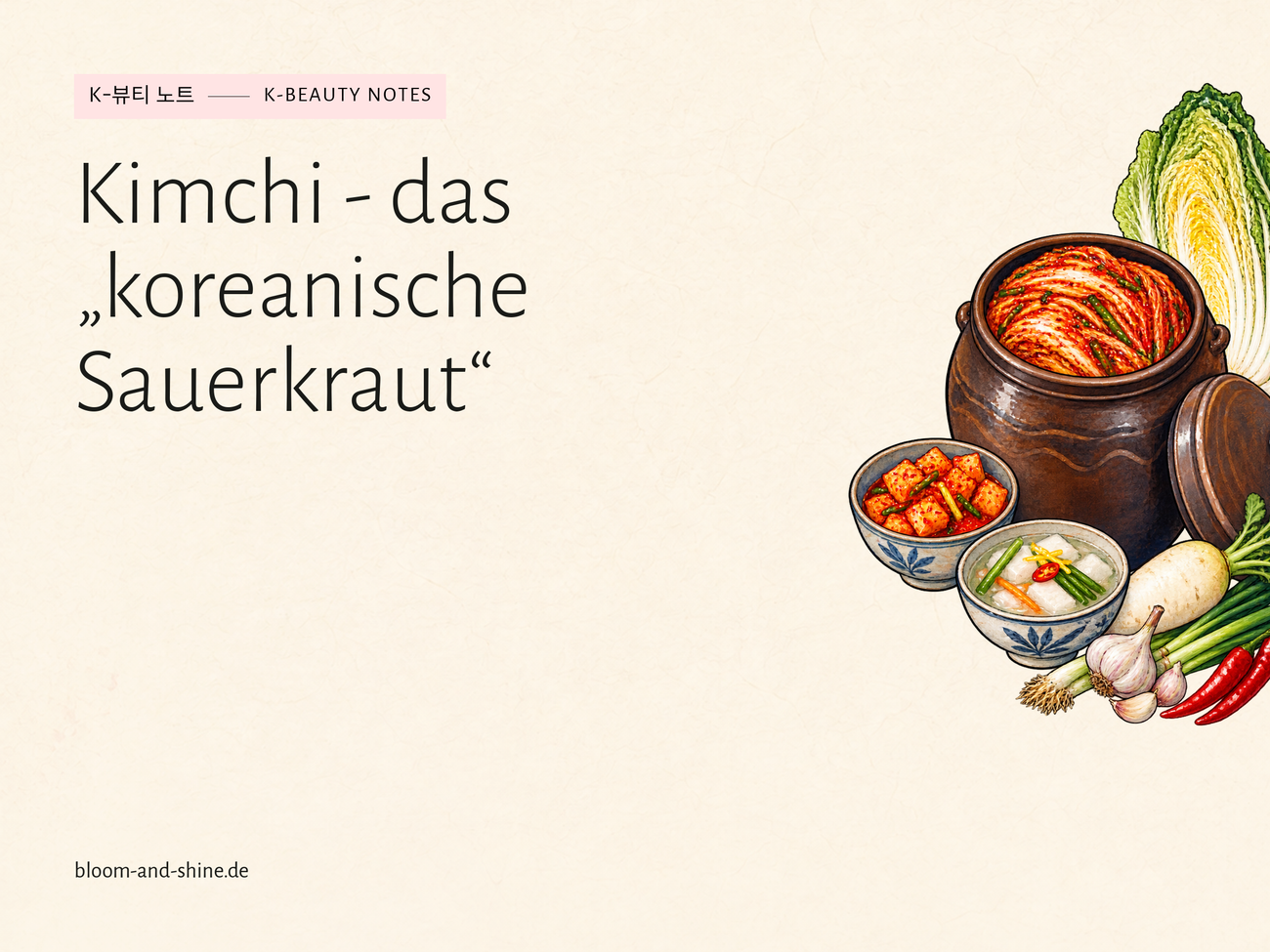
Kimchi – the “Korean sauerkraut”
There are often many small bowls on a Korean table. One of them glows red, smells of garlic and doesn’t wait patiently to appear. Kimchi is a side dish. It rarely behaves like a supporting role.
It is sometimes called “Korean sauerkraut”. The comparison works as a first orientation: both are made from salted vegetables and lactic acid fermentation. Afterwards they part ways. Kimchi is much more than fermented cabbage and has countless ingredients, seasonings and shapes.
Sometimes even when taking photos it is not “cheese” but “kimchi”. The word also forms the mouth into a smile – and also tells how naturally the dish is part of everyday life.
One name, many flavors
If you only think of spicy Chinese cabbage when you think of kimchi, you are primarily familiar with the most famous member of the family.
Kimchi can be made from radish, cucumber, scallions, mustard leaves or many other ingredients. There are strong, mild and water-rich versions. White kimchi even comes without the familiar red color.
Region, season and household also change taste. Near the coast, fish or seafood can play a larger role. Elsewhere, vegetables, salt and reserved seasoning take center stage. A single definitive kimchi recipe would therefore be about as compelling as a single definitive bread formula.
When time cooks
The vegetables are salted, seasoned and allowed to ripen. During this time, microorganisms change the taste. Acidity develops, flavors become deeper and crunchy vegetables become something that can taste fresh and ripe at the same time.
How kimchi ends up depends on the ingredients, temperature and time. That’s why some households have their own kimchi refrigerator. It’s less a status symbol than a precise quiet place for something that is constantly evolving.
What fermented foods have to do with the skin
A varied diet also nourishes the skin. Vitamin C contributes to normal collagen formation for normal skin function. Depending on the vegetable, formula and degree of ripeness, kimchi can provide vitamin C, other vitamins, minerals and fiber. A good supply of vitamins can have a positive effect on the complexion, especially if there was previously a deficiency. However, a single food does not automatically improve the complexion.
When it comes to inflammation, precision is also worthwhile. In a small randomized trial, a diet containing a variety of fermented foods resulted in greater gut microbiome diversity and lower levels of several inflammatory markers. An entire food group was examined, not kimchi as a therapy. It does not follow that kimchi treats skin inflammation.
There are initial interesting studies on individual lactic acid bacteria and fermented ingredients for the skin barrier. These results cannot simply be extrapolated to every jar of kimchi. A balanced supply of protein, essential fatty acids, vitamins and minerals helps the skin maintain and renew its barrier. Fermented foods can be a part of this diet. Care and sun protection remain just as important.
Other fermented foods
- Sauerkraut
- Kimchi
- Traditional lactic fermented pickles
- Kefir
- Yoghurt
- Apple cider vinegar
Not every product contains live cultures when eaten. Heating, filtering or pasteurizing can reduce or remove microorganisms. Pickled cucumbers are also not automatically fermented salted cucumbers.
Fermentation – very briefly
Vegetables are washed, chopped and mixed with salt. As a guide, the Federal Center for Nutrition gives around two to five percent salt based on the total amount, depending on the formula.
Then the vegetables are pressed firmly into a clean jar and kept completely under their own liquid or a brine. There, lactic acid bacteria convert sugar into acids. After a few days to weeks, the sufficiently acidic ferment is stored in a cool place.
A tested formula makes sense for the first attempt. If there is mold, noticeable discoloration or a foul smell, the entire ferment is discarded.
Kimjang means more than storage
In late autumn, larger quantities of kimchi are traditionally prepared for the winter. This collaborative process is called Kimjang . Families and neighborhoods share work, formulas and finished kimchi.
In 2013, UNESCO added the preparation and sharing of kimchi in the Republic of Korea to the Representative List of the Intangible Cultural Heritage of Humanity. It was not a single formula that was honored, but rather the knowledge and social practice surrounding joint production.
Perhaps this is the most important difference: kimchi is not an unchanging national formula. It is a method, a taste memory and often a reminder of who was at the table.
Legal Disclaimer: Kimchi can provide different nutrients depending on the ingredients and production. However, the actual quantities vary greatly. From studies on fermented diets, no specific effect of kimchi on skin appearance, inflammation or the skin barrier can be derived.
Sources
- UNESCO: Kimjang, making and sharing kimchi in the Republic of Korea
- Museum Kimchikan: Kimchi according to ingredients
- Museum Kimchikan: Regional kimchi variants
- Museum Kimchikan: Korean standard for traditional kimchi products
- Korea.net: Two sayings about kimchi in everyday Korean life
- Cell/PubMed: Fermented food diet, microbiome and inflammatory markers
- PubMed: Nutrient profiles of different types of kimchi
- PubMed: Small Human study on a kimchi-derived lactic acid bacterium and skin parameters
- PubMed: Small human study on a specific lactic acid bacterium and the skin barrier
- EU registry: Vitamin C and normal collagen formation for skin function
Federal Center for Nutrition: Fermenting vegetables